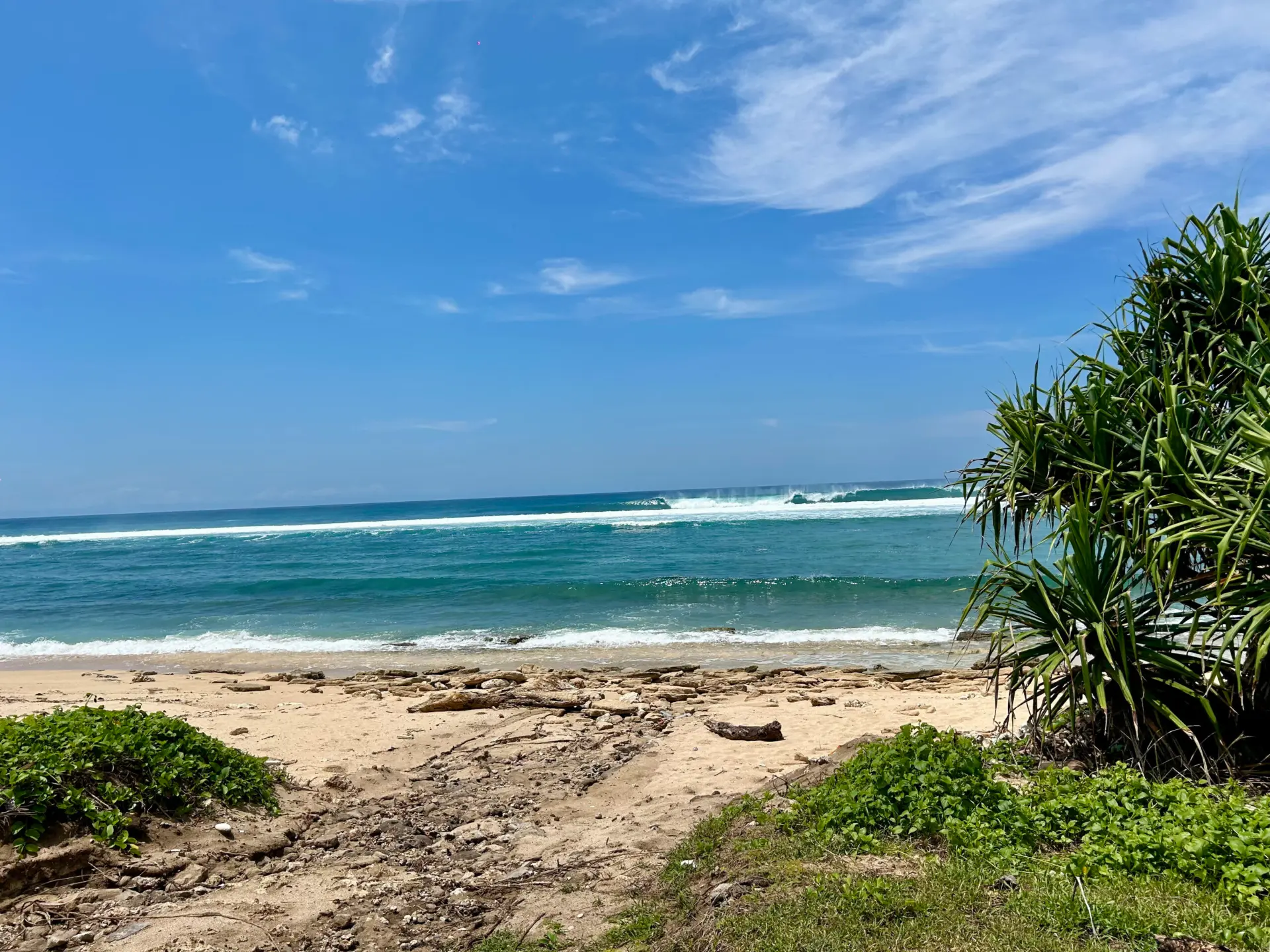

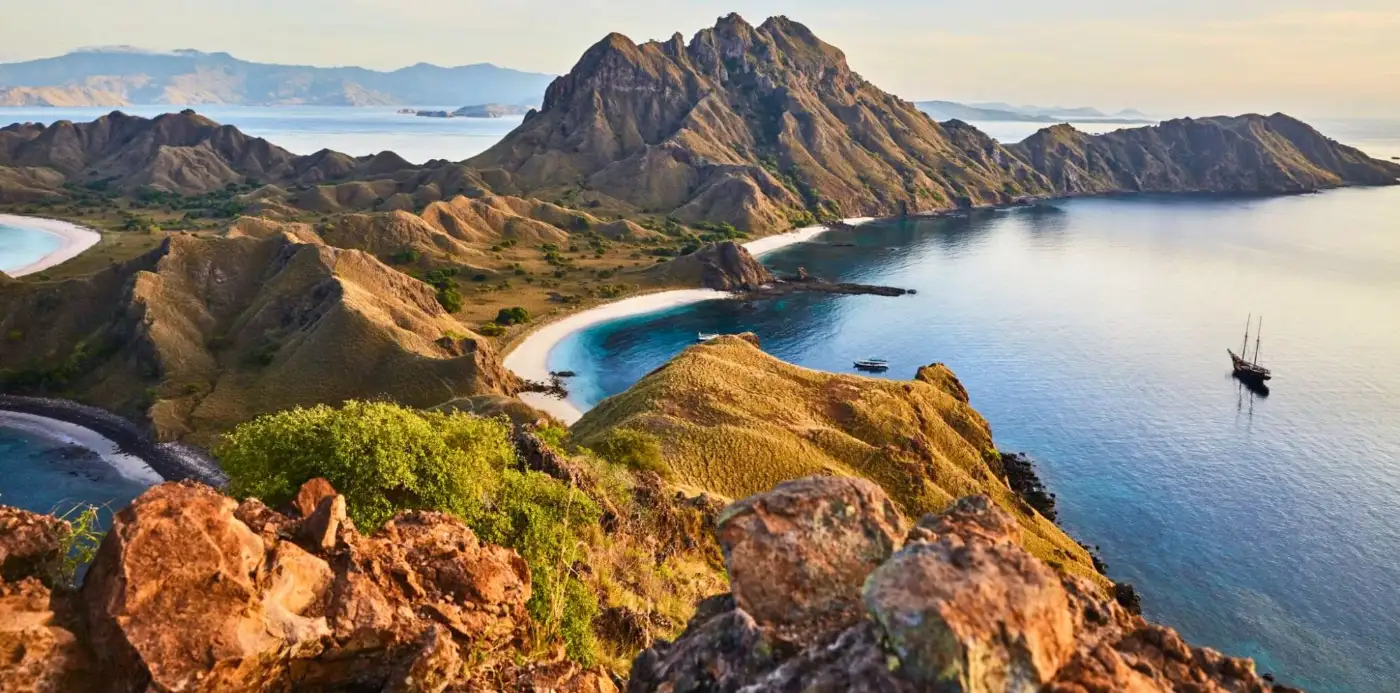
Sumba does not look like the rest of Indonesia. Instead of dense rainforest it has open savannah, rolling grass hills and long empty coastline — a landscape people routinely compare to East Africa rather than to Bali. Within that setting sit saltwater lagoons, canyon waterfalls, mangrove beaches and two national parks. This is a guide to the places worth seeing, and to what the terrain means if you are looking at land here.
The short version
- Weekuri Lagoon — a saltwater lagoon behind a rock barrier in the southwest.
- Tanggedu Waterfall — terraced turquoise pools in East Sumba, nicknamed the island’s Grand Canyon.
- Walakiri Beach — the “dancing” mangroves at sunset, near Waingapu.
- Lapopu and Matayangu — jungle waterfalls inside Manupeu Tanah Daru National Park.
- Wairinding Hills — the rolling savannah that defines the island’s look.
- Two national parks: Manupeu Tanah Daru and Laiwangi Wanggameti.
The coast
Weekuri Lagoon
In Southwest Sumba, near the island’s western tip. Weekuri is a clear saltwater lagoon separated from the open Indian Ocean by a low rock barrier, so it fills and refreshes with the tide while staying calm enough to swim in. Ocean swell breaks against the rock on one side; on the other the water is still. The cliffs around it give you the view that appears in most photographs of the place, and there is deep enough water for jumping in from the platforms.
Walakiri Beach
On the north-east coast near Waingapu, and the island’s most photographed sunset. Walakiri’s shallow flats are studded with low mangrove trees whose shapes read as figures in silhouette — hence “dancing trees.” At low tide you can walk far out among them. It is a sunset beach rather than a swimming beach.
The south coast
The southern shoreline is where Sumba’s scale registers. Long beaches backed by cliffs and grass, reef offshore, and very few people. Much of it is reached by unsealed road and some of it is not reached by road at all. This is also where the island’s surf breaks sit — covered separately in our guide to surfing in Sumba.
The waterfalls
Tanggedu
In East Sumba, and the most striking of the island’s waterfalls. Tanggedu runs over terraced rock into a series of turquoise pools, with the surrounding stone cut into shelves and channels — which is where the “Grand Canyon of Sumba” label comes from. It is a proper outing: the last stretch is on foot across hills and fields, and the road in is rough. Go in the dry season and the water is at its clearest; go after heavy rain and it is powerful but brown.
Lapopu and Matayangu
Both sit within Manupeu Tanah Daru National Park in West Sumba, in genuine forest rather than savannah. Lapopu is among the tallest falls on the island, dropping in tiers into a pool at the base. Matayangu is smaller and quieter and takes a walk through forest to reach. The park itself is the island’s main remaining block of tropical forest and holds bird species found nowhere else.
The interior
Inland Sumba is the part visitors do not expect. Wairinding Hills, near Waingapu, is the best-known viewpoint — wide, treeless, rolling grassland that turns gold in the dry season and green after rain, with nothing built on it in any direction. It is the landscape that gives Sumba its reputation for looking like somewhere other than Southeast Asia.
The island’s two national parks protect the other side of that picture. Manupeu Tanah Daru in the west and Laiwangi Wanggameti in the southeast between them hold Sumba’s remaining forest, its watersheds and a set of endemic birds that draw specialist visitors.
And there are the horses. Sumba’s sandalwood ponies are woven into the island’s culture and are still used, still bred, and still ridden on the beaches — which is why nearly every piece of international travel writing about the island mentions them.
When to go, and what changes
Sumba has a hard dry season and a distinct wet one, and they produce two visibly different islands.
| Season | Months | What it looks like |
|---|---|---|
| Dry | Roughly May – October | Gold savannah, clear water at the lagoons and falls, best road access, best surf |
| Wet | Roughly November – April | Green hills, powerful but murky waterfalls, some tracks difficult or impassable |
For photography and swimming, the dry season wins. For seeing the landscape green — and for the Pasola ceremony, which falls in February and March — the wet season has its own case. Note that road conditions are the real variable: several of the best sites are at the end of tracks that behave very differently in the rain.
What the landscape means if you are buying land
Terrain on Sumba is not just scenery. It decides what a site is worth and whether it is buildable at all.
Elevation versus beachfront
Clifftop and elevated parcels get the long views, better breeze, fewer mosquitoes and more protection from storm surge. Beachfront gets direct access and the premium that comes with it. Both work; they are different products, and the price difference between them on Sumba is often smaller than it would be elsewhere.
Water is the deciding factor
In a savannah climate with a long dry season, whether a plot has a viable water source is the question that outranks every other. Bore depth, dry-season yield and what neighbouring properties are drawing all need to be established before purchase, not after.
Access, drainage and slope
Look at a site’s access road as it is in the wet season, not the dry. Check where water runs across the parcel in heavy rain. On sloped clifftop land, ask about stability and setback from the edge. These are the site conditions that quietly turn a bargain into an expensive problem.
Proximity to the things people come for
Land near a recognised natural feature — a lagoon, a good beach, a surf break, a viewpoint — carries demand that generic inland land does not. That is the pattern everywhere, and it holds here.
Current asking levels by area are in the Sumba land price report, and the areas themselves are compared in the best areas to buy land in Sumba.
Frequently asked questions
What is Sumba island known for naturally?
Open savannah and rolling grass hills rather than rainforest, long undeveloped coastline, saltwater lagoons such as Weekuri, canyon-like waterfalls such as Tanggedu, mangrove beaches such as Walakiri, and its sandalwood horses. Two national parks — Manupeu Tanah Daru and Laiwangi Wanggameti — protect the island’s remaining forest and endemic birdlife.
What is the best time to visit Sumba for nature?
The dry season, roughly May to October. Water at the lagoons and waterfalls is clearest, road access to remote sites is most reliable, and the savannah takes on its characteristic gold. The wet season, November to April, turns the hills green and makes the waterfalls more powerful but murkier, and some tracks become difficult.
Is Weekuri Lagoon worth visiting?
Yes. It is a clear saltwater lagoon separated from the open ocean by a rock barrier, calm enough to swim in, with cliff viewpoints above it. It is one of the island’s few genuinely easy natural attractions to enjoy without a long hike.
How do you get to Tanggedu Waterfall?
It is in East Sumba, most easily reached from Waingapu. The drive is on rough road and the final approach is a walk across hills and fields. Allow the better part of a day, go with a local guide or driver, and prefer the dry season when the water runs clear.
Does Sumba have rainforest?
Only in patches. Most of the island is savannah and grassland with a pronounced dry season. The remaining tropical forest is concentrated in the two national parks, Manupeu Tanah Daru in the west and Laiwangi Wanggameti in the southeast.
Land for sale by area: Rua · Wanokaka · Pero & Kodi · East Sumba
More on Sumba
- Surfing in Sumba — the breaks along the same coastline
- Why Sumba is still undeveloped — why this landscape is still intact
- Land for sale in Sumba — plots currently available
Sources
- Manupeu Tanah Daru National Park — the protected forest and the Lapopu waterfall
- Sumba (Wikipedia) — island geography, rivers and dry-season water
Land with a view worth building forClifftop, beachfront and elevated parcels across Sumba — with access, water and title checked as part of the due diligence before you commit.