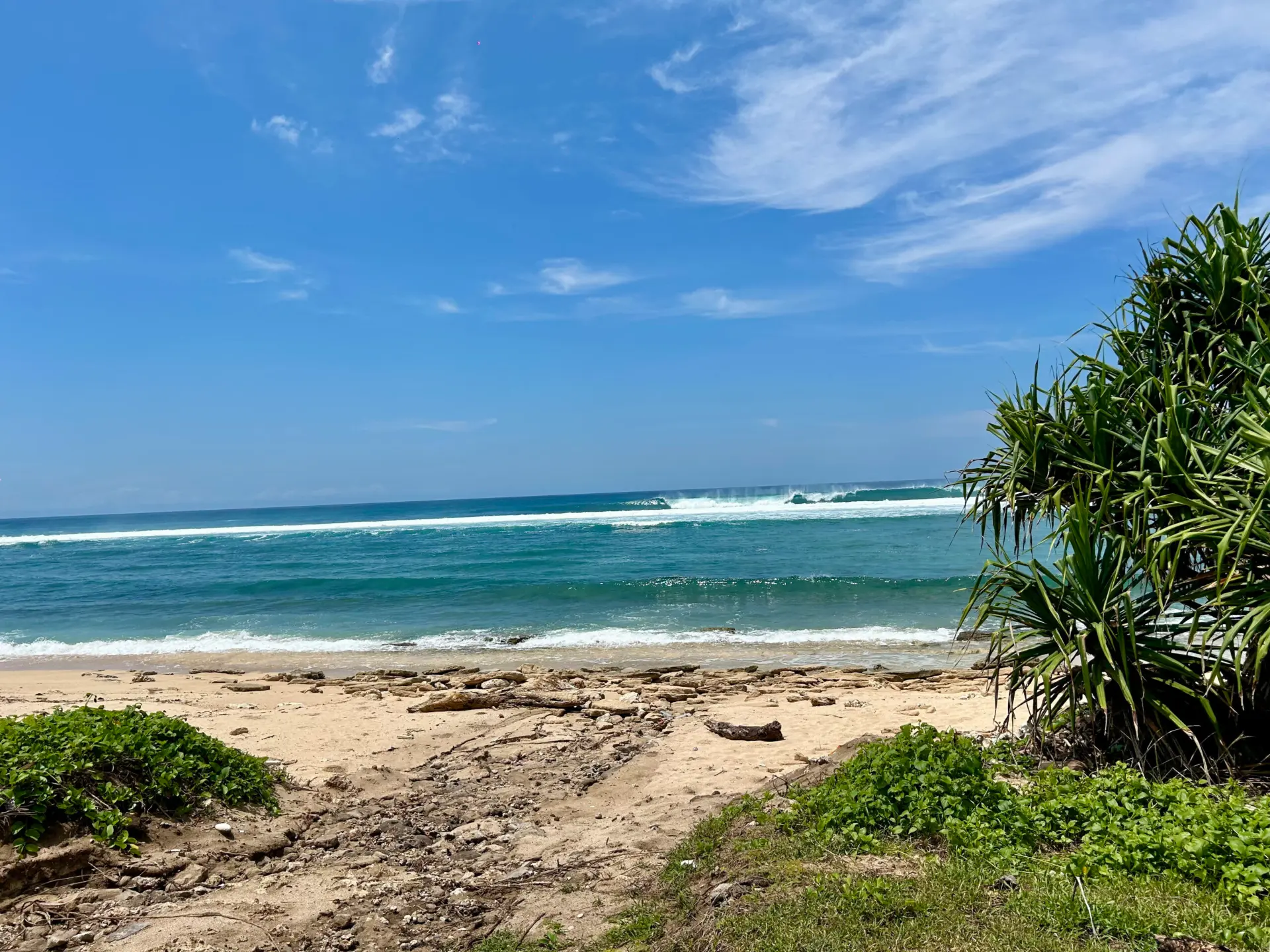


Sumba has some of the best surf in Indonesia and almost none of the crowds. Its southern coast faces straight into open Indian Ocean swell, the breaks are reef, and the line-ups are measured in single figures rather than dozens. The island’s most famous wave — Occy’s Left at Nihiwatu — is world class and effectively private. The rest are open to anyone willing to make the drive.
The short version
- Main season: roughly April to October, with south and southwest groundswell.
- Coast: the south and southwest — the north side is largely sheltered.
- Bottom: almost all reef. Booties and a basic first-aid kit are not optional.
- Crowds: a handful of surfers at most spots, even in peak season.
- Airports: Tambolaka (TMC) in the west, Waingapu (WGP) in the east — about an hour’s flight from Bali.
The surf breaks that made Sumba’s name
Occy’s Left (Nihiwatu)
The island’s signature wave, on the south coast in front of the Nihi Sumba resort. It is a long, powerful left-hander that runs down a reef shelf with real speed and genuine barrel sections. The name comes from the Australian professional surfer Mark Occhilupo, who surfed it in the early years when almost nobody else had.
The important detail is access: the wave sits on resort-controlled beachfront and is reserved for guests. That restriction is exactly why a wave of this quality still has empty line-ups — it is probably the least crowded world-class wave in Indonesia. If you are not staying at the resort, treat it as something you look at rather than something you surf.
Kerewei
A right-hand point at the western end of the same stretch of coast, and the wave most surf camps on Sumba are built around. It runs for roughly five hundred metres when the conditions line up. It works best on southwest swell with some period behind it — fourteen to sixteen seconds is the sweet spot — and prefers a medium tide pushing towards high. Chest-high to a couple of feet overhead is where it holds its shape best.
Pero
In the far southwest, near the fishing village of the same name. Pero offers both a left and a right off the edge of a reef, finishing on sand, and it is one of the more consistent spots on the island. It is also one of the more forgiving ones: a competent intermediate can surf Pero on a normal day, which is not true of everywhere here.
Marosi
An exposed reef break on the south coast that picks up more swell than most. Clean groundswell from the southwest is what it wants, and the dry season — May through October — is when it delivers. Because it is exposed, it can be too much on a big day and perfect on a moderate one.
Tarimbang
Further east, in East Sumba, and probably the most surfed wave on the island simply because it is the most accessible one that is not behind a resort gate. Tarimbang is a right-hand reef break with a fast, hollow top section that softens into a rideable shoulder, which makes it unusually broad in who can surf it. Its best window runs April to October.
When to go: Sumba’s swell season
Sumba runs on the same rhythm as the rest of southern Indonesia. The dry season, broadly May to October, brings the consistent south and southwest groundswells and the offshore trade winds. That is the core season.
The shoulder months — April and October — are worth knowing about. The swell is already arriving but the trades have not fully settled in, which means the lefts and the rights can both be good on the same day. In the middle of the season the wind pattern tends to favour one orientation over the other.
| Period | Swell | Wind | Crowds |
|---|---|---|---|
| April | Building | Variable — both directions surfable | Very low |
| May – September | Most consistent | Settled trades | Low |
| October | Still good | Easing — both directions again | Very low |
| November – March | Inconsistent | Wet season, onshore | Almost none |
What surfing here is actually like
Sumba is not a surf destination in the way that Canggu or Uluwatu are surf destinations. There is no warung strip behind the break, no board hire on every corner, and no queue of scooters. Getting between spots means real driving on roads that vary from decent asphalt to broken track, and the two ends of the island are several hours apart.
The other thing worth saying plainly: medical facilities on Sumba are limited. Reef cuts are the normal injury here and they need to be cleaned properly and quickly. Most experienced visitors carry antiseptic, and anyone surfing regularly wears booties.
What you get in exchange is the thing that no longer exists in Bali — a good wave with three people on it, on a coastline where you can drive for an hour and pass one village.
What this means if you are looking at land
Surf is one of the clearest long-term demand signals on Sumba. Wherever a quality break is within reasonable reach of a road, land values behave differently from the surrounding area, and that pattern has repeated on every Indonesian island that developed before this one.
The practical questions for a coastal plot near a break are the ones people forget to ask: is there legal, physical access to the beach, or does the neighbouring parcel control it? What is the elevation, and what does the site look like in the wet season? Is the plot on certified title or customary (adat) land, and if the latter, what does the release process actually involve?
We cover that last point in detail in our guide to customary land and due diligence in Sumba, and the wider process in how to buy land in Sumba as a foreigner. For what land near the coast is currently trading at, see the Sumba land price report.
Frequently asked questions
Can you surf Occy’s Left without staying at Nihi Sumba?
No. The wave sits on beachfront controlled by the resort and surfing it is limited to guests. That restriction is the reason the wave has stayed uncrowded for decades.
When is the best time to surf in Sumba?
The dry season, roughly May to October, is the main swell window. April and October are the shoulder months and are often the best of both worlds, because the swell has arrived but the trade winds have not locked into one direction yet.
Is Sumba suitable for beginner surfers?
Mostly no. Almost every break on the island is reef, several are powerful, and the nearest proper medical care can be a long drive away. Pero and the softer shoulder at Tarimbang are the most forgiving options, but Sumba is best treated as an intermediate-and-above destination.
How do you get to Sumba’s surf spots?
Fly into Tambolaka (TMC) for the western and southwestern breaks, or Waingapu (WGP) for Tarimbang and the east. Both are roughly an hour from Bali. From there it is car or motorbike — there is no public transport network connecting the breaks.
Are the waves in Sumba crowded?
No. Outside the resort-controlled wave, most spots see a handful of surfers even in peak season, and many days you will share a break with fewer than five people.
Land for sale by area: Rua · Wanokaka · Pero & Kodi · East Sumba
More on Sumba
- Why Sumba is still undeveloped — what keeps the island quiet, and how long that lasts
- Luxury resorts in Sumba — who else has already built here
- Sumba’s lagoons and waterfalls — what the coastline looks like away from the reef
Sources
- Sumba (Wikipedia) — island geography, population and infrastructure
- Nihi Sumba — the resort that controls access to the Occy’s Left break
Land near Sumba’s south coastBeachfront and clifftop plots within reach of the island’s surf breaks, with title and access checked as part of the due diligence before you commit.
Wave descriptions and seasonal windows in this article reflect published surf guides and forecast data for Sumba. Conditions at reef breaks change with swell, tide and wind — always check a current forecast and ask locally before paddling out.