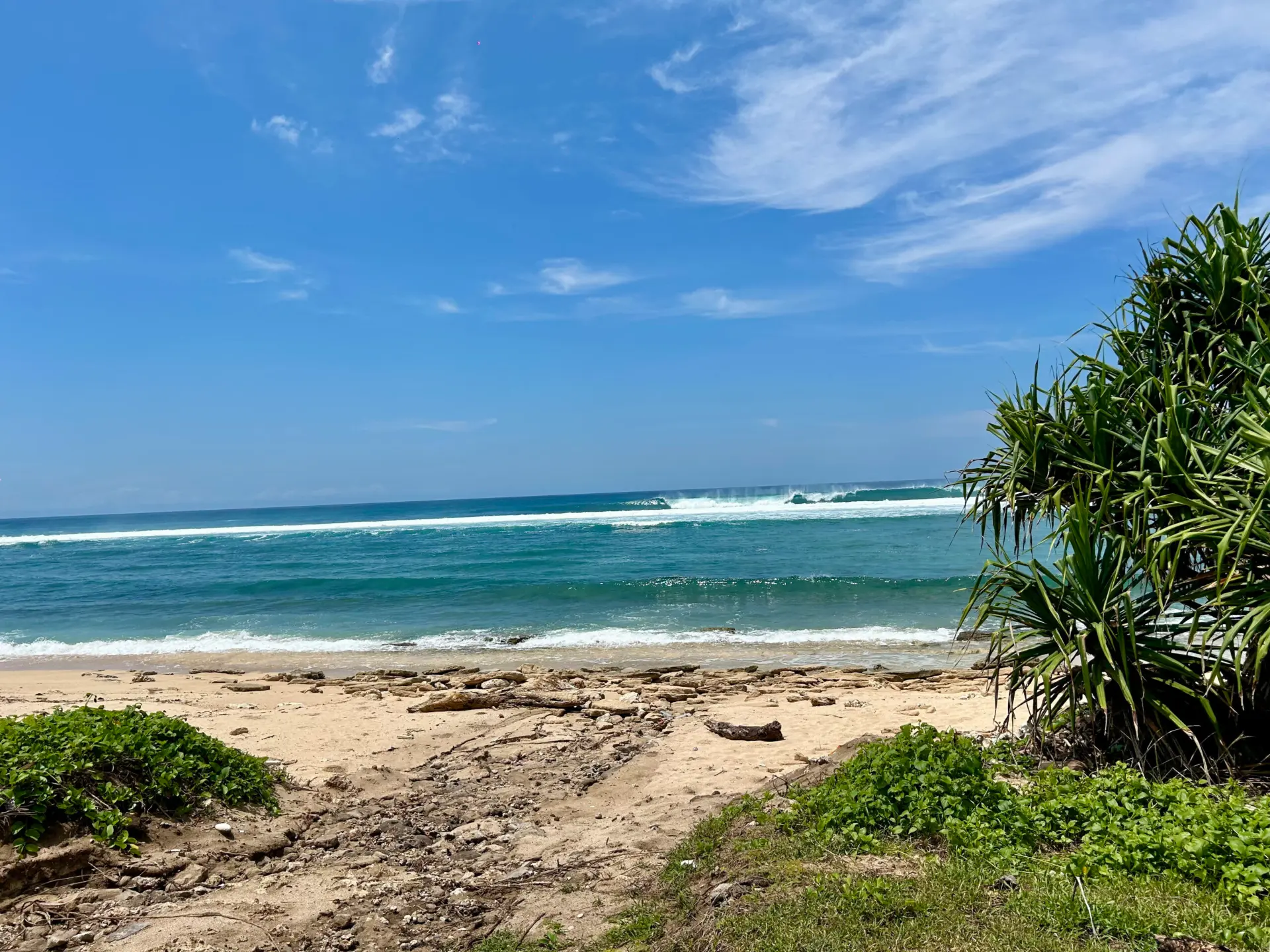


Sustainability on Sumba is not a marketing position. It is a constraint. Large parts of the island have no mains water, patchy grid electricity and no municipal waste collection, so anything built here has to generate, store and dispose of most of what it uses on site. That reality is what has shaped how the island is being developed — low density, large plots, off-grid systems — and it is why Sumba is being built differently from the islands that came before it.
The short version
- Sumba was selected in 2010 as Indonesia’s Iconic Island for 100% renewable energy, in a programme run by Hivos with Winrock International.
- The Indonesian government issued a decree placing the Ministry of Energy in charge of delivering it.
- Electrification rose from 24.5% in 2010 to 42.67% in 2015, with roughly 17% of that generated renewably.
- Most serious development on the island is off-grid by necessity: solar, rainwater capture, on-site wastewater treatment.
- Plots are large and building density is low — the opposite of the pattern that saturated southern Bali.
Sumba Iconic Island: the programme behind the island’s energy story
In 2010 the Dutch development organisation Hivos, working with Winrock International, ran a study to find an Indonesian island that could realistically be moved to entirely renewable power. Sumba came out on top — not because it was the easiest, but because it had the best combination of resource potential and institutional willingness. The island has strong solar, significant biomass, and real hydro and wind potential.
The result was the Sumba Iconic Island initiative, aimed at supplying the island’s population — then estimated at around 750,000 people — with reliable, fully renewable energy and ending its dependence on diesel. The Indonesian government backed it with a decree assigning responsibility to the Ministry of Energy and Mineral Resources, and a task force was set up to run the roadmap.
Progress has been real but not linear. Electrification across the island climbed from 24.5% in 2010 to 42.67% by 2015, with close to a fifth of that supply renewable. The programme has been used internationally as a case study in how island-scale renewable transitions actually work, including by the Asian Development Bank.
For anyone building on Sumba, the practical takeaway is this: the direction of travel is towards distributed renewable supply, not towards a conventional grid rollout. Designing a property to run on its own solar array is not an eccentric choice here. It is the mainstream one.
Why low density is structural, not stylistic
The reason villas on Sumba sit on large plots is not aesthetic preference. It is arithmetic.
A property that is off-grid needs physical space for the things a city hides: a solar array sized for its actual load, battery storage, water storage tanks, a bore or well, a septic or constructed-wetland treatment system, and enough separation from the neighbouring parcel that one property’s wastewater does not reach another property’s water source. Pack those requirements onto a small plot and the systems start to interfere with each other.
The second reason is water. Much of Sumba has a pronounced dry season and a savannah rather than rainforest climate. Water availability varies enormously between locations and between seasons, and it is the single most common reason a site that looks perfect on a map turns out not to work. Density that a wetter island can absorb, Sumba cannot.
What building responsibly here actually involves
Stripped of the brochure language, sustainable building on Sumba comes down to a short list of decisions made early.
Water before anything else
Establish, before purchase, what the water situation is: whether there is a viable bore, at what depth, what the yield is in the dry season rather than the wet one, and what the neighbouring properties are drawing. Rainwater capture and storage should be designed for the dry months, not the average.
Power sized to the real load
Solar plus battery storage is the default. The mistake is sizing the array to the sunny-season load and then discovering that a wet-season week of cloud empties the batteries. A generator as backup is normal; a generator as the primary source is expensive and noisy in a place people come to for quiet.
Wastewater that does not reach the sea
On a coastal plot this matters more than anywhere. Constructed wetlands and properly engineered septic systems both work; the failure mode is an undersized system on a slope above a beach or a well.
Materials and labour from the island
Local stone, timber, bamboo and alang-alang thatch perform well in this climate, cost less than imported alternatives once freight is counted, and can be maintained by people who live nearby. Shipping materials to Sumba is slow and expensive, which quietly makes the sustainable choice the economic one.
Setbacks and elevation
Coastal setback and building rules vary by regency and are enforced locally. Confirm what applies to a specific parcel before designing anything, rather than assuming the rules that apply elsewhere in Indonesia apply here.
The examples already on the island
Sumba’s hospitality sector has been the visible proof that this approach works commercially. Nihi Sumba built its reputation partly on conservation and on the Sumba Foundation, which channels funding into water access, health and schooling in surrounding communities. Maringi Sumba is operated by the Sumba Hospitality Foundation as a working eco-resort where local students train for hospitality careers, with an organic farm attached. Cap Karoso, in the southwest, runs its restaurants off its own farm.
None of these are small gestures bolted onto conventional resorts. They are the operating model. That matters for land buyers because it sets the expectation that new development on Sumba justifies itself — and because it is the reason the island still looks the way it does.
What this means for buyers
If you are buying land here, the sustainability question is really a due-diligence question. Water yield, solar orientation, drainage, slope stability, distance to the nearest neighbour’s systems and the legal status of the parcel all need to be established before money moves — and several of them cannot be assessed from photographs.
It is also worth understanding how land is held. A significant amount of Sumbanese land is customary (adat) land, tied to clan and community rather than to an individual, and the process of releasing it into certified title is its own subject. We set it out in customary land in Sumba and how to check it, and the wider purchase route in how to buy land in Sumba as a foreigner.
Frequently asked questions
Is Sumba really powered by renewable energy?
Not entirely, and not yet. Sumba was selected in 2010 as Indonesia’s Iconic Island for 100% renewable energy, with government backing and a dedicated task force. Electrification rose from 24.5% in 2010 to 42.67% in 2015, with roughly 17% of that renewable. The target is full renewable supply; the island is on the road, not at the end of it.
Do properties in Sumba have mains water and electricity?
Many do not. Grid coverage is uneven and mains water is unavailable across large parts of the island. Most villas and resorts run on solar with battery storage, a bore or well, rainwater capture and on-site wastewater treatment. Budget for those systems as part of the build, not as extras.
Can you build a villa off-grid in Sumba?
Yes — it is the normal approach rather than the exception. A correctly sized solar array with storage, adequate water storage for the dry season, and an engineered wastewater system will run a villa year-round. The design work has to be done properly, because there is no utility to fall back on.
Why are plots in Sumba so large?
Because off-grid infrastructure needs space, water is seasonal and finite, and low building density is what protects the thing buyers are coming for. Large parcels are also simply how land has historically been held and transacted on the island.
What is the Sumba Foundation?
It is the charitable foundation connected to Nihi Sumba, funding water access, healthcare and education projects in communities around the resort. It is the best-known example of Sumba’s hospitality sector reinvesting locally.
Land for sale by area: Rua · Wanokaka · Pero & Kodi · East Sumba
More on Sumba
- Why Sumba is still undeveloped — the starting point this development has to work from
- Marapu, Pasola and ikat — the culture any project on Sumba has to sit alongside
- Sumba real estate FAQ — ownership, titles and the legal route for foreigners
Sources
- Hivos — Sumba Iconic Island Initiative — the 100% renewable-energy programme and its electrification figures
- Sumba (Wikipedia) — population, area and the island’s energy and water constraints
Plan a lighter footprint from the first visitBrowse plots across Sumba, ask about water, access and power early, and have title and boundaries checked by a notary (PPAT), an independent surveyor and the land office (BPN) before you commit. We work with reliable local partners and can refer you to them.
Energy figures cited here come from published reporting on the Sumba Iconic Island initiative by Hivos, Winrock International and the Asian Development Bank. Building and setback requirements vary by regency and should be confirmed for each specific parcel.