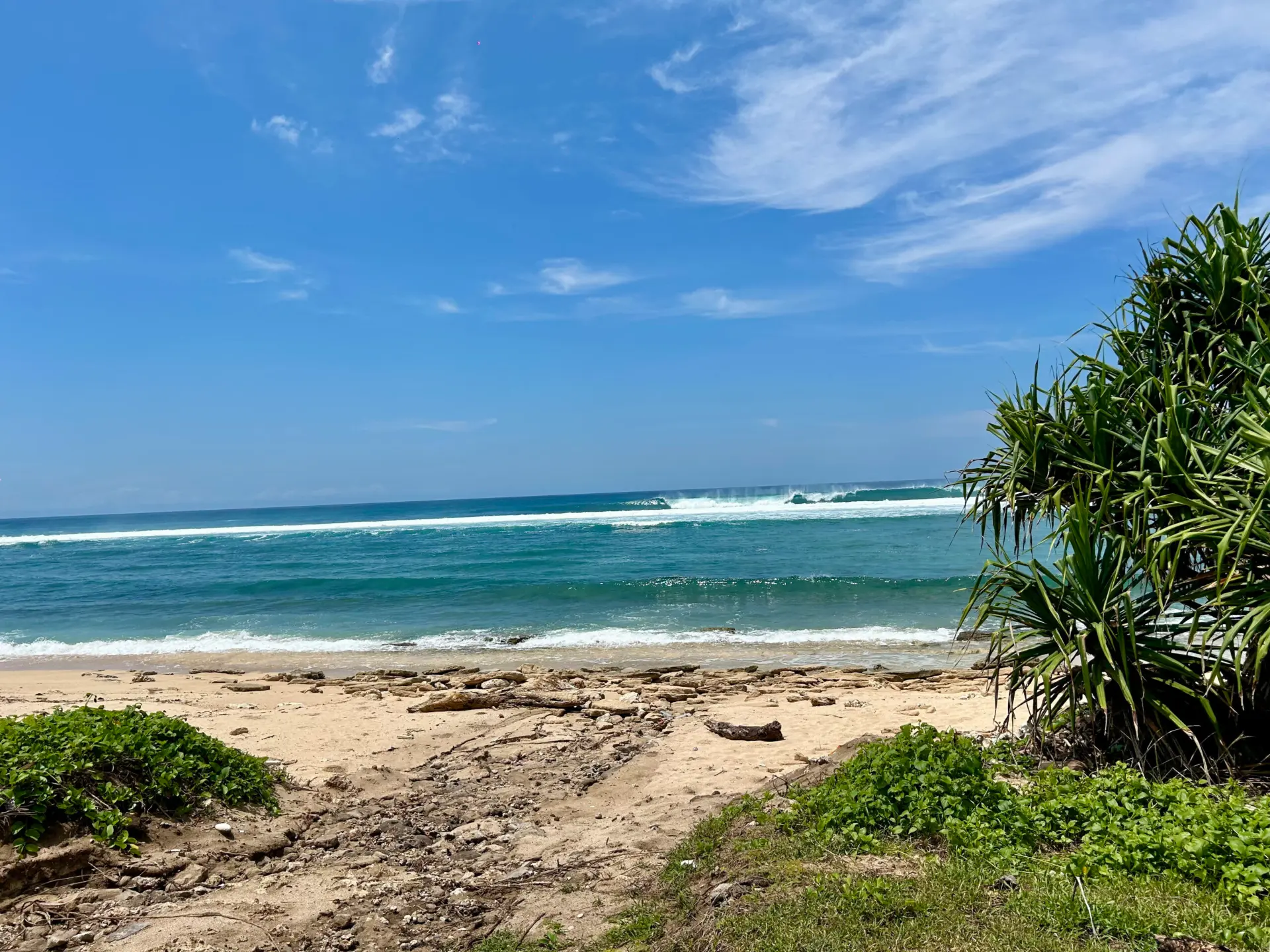


Sumba is roughly twice the size of Bali and has about a fifth of the population. It sits an hour’s flight away from one of the most visited islands on earth, and almost nobody goes there. That gap is not an accident or an oversight — there are specific, identifiable reasons Sumba stayed undeveloped while Bali, Lombok and the Gilis did not. Understanding those reasons is the difference between buying early and buying badly.
Sumba and Bali, side by side
- Land area: Sumba roughly 10,900 km²; Bali roughly 5,780 km².
- Population: Sumba around 850,000; Bali around 4.4 million.
- International visitors: Bali receives over six million a year. Sumba’s figure is estimated in the tens of thousands.
- Access: two airports — Tambolaka (TMC) in the west and Umbu Mehang Kunda (WGP) at Waingapu in the east — each about an hour from Bali.
Why Sumba stayed undeveloped
1. Access was, and largely still is, limited
Sumba has two airports and a modest number of flights, almost all of them routed through Bali or Kupang. There is no international arrival. Every visitor and every container of building material takes an extra leg to get here, and that single friction point has done more to slow development than any policy ever could.
2. The island is dry
Much of Sumba is savannah rather than rainforest, with a hard dry season. That climate produces the open, rolling landscape the island is known for, but it also means water availability varies sharply by location and by season. Water is the constraint that decides whether a site is buildable, and it has ruled out a great deal of otherwise attractive land.
3. Land is held customarily
A large share of Sumbanese land is adat land — customary land held by clan and community rather than by individuals, and governed by traditional authority alongside the national system. It cannot simply be bought from a seller with a certificate, because in many cases there is no certificate. Releasing customary land into certified title is a real process involving the community, and it takes time. That single fact has kept large-scale speculative assembly out of Sumba.
4. There was no hotel supply to build demand on
Tourism grows where beds exist. Sumba had almost none until Nihiwatu — now Nihi Sumba — put the island on the international map, and even now the island’s inventory is a few hundred rooms, not a few hundred thousand. Low bed count means low visitor numbers means slow development. That loop has held for decades.
5. Infrastructure is thin
Roads range from decent to rough. Grid coverage is patchy. Mains water is unavailable across large areas. There is no municipal waste collection in most places. These are solvable problems at the scale of a single property, but they are serious barriers to mass-market development, and they have kept the volume builders away.
What “untouched” actually looks like on the ground
The practical version of the statistics is simple. There are no traffic jams. There are stretches of coastline where you can drive for an hour and pass one village. Beaches that would carry a beach club anywhere else carry a fishing boat and a horse. The Pasola ceremony is a real religious event, not a scheduled performance, and megalithic tombs sit in village squares where families actually live.
It also means the things travellers take for granted elsewhere are absent. Convenience stores are rare outside the towns. Restaurants along a road trip are not a given. Medical facilities are limited. Sumba is genuinely remote, and that is the whole point — but it is worth being clear-eyed about it.
What this means for land buyers
An undeveloped market is an opportunity and a risk in the same breath, and it is worth separating the two.
| The opportunity | The corresponding risk |
|---|---|
| Land prices are a fraction of comparable coastal Bali | Liquidity is thin — exit takes longer than in a mature market |
| Genuine beachfront and clifftop parcels are still available | Access to the beach may be legally controlled by a neighbouring parcel |
| Large plots, low density, no competing development next door | All infrastructure is your responsibility — water, power, waste, road |
| Hospitality is arriving and validating demand | Rental demand today is small; this is a medium-term position |
| Title can be clean and defensible when properly established | Customary land requires a real release process, correctly documented |
The single most important discipline in a market like this is verification. In a mature market the paperwork is usually in order and the questions are about price. Here, the paperwork is the question. Who holds the land, under what form of title, with what community consent, and with what physical and legal access — those need answering before price is even relevant.
How long does this window stay open?
Nobody honestly knows, and anyone who gives you a date is guessing. What can be said is that the constraints listed above are the things that would need to change, and some of them are changing: flight capacity into Tambolaka, road quality, and the slow arrival of hospitality operators who bring their own infrastructure with them.
What is not changing quickly is the customary land system, the dry-season water constraint, or the island’s distance from an international airport. Those are structural, and they are the reason Sumba is unlikely to follow Bali’s curve at Bali’s speed.
For current asking prices by area, see the Sumba land price report. For the comparison in detail, see Sumba vs Bali. And for the mechanics of a foreign purchase, see how to buy land in Sumba as a foreigner.
Frequently asked questions
How big is Sumba compared to Bali?
Sumba covers roughly 10,900 square kilometres against Bali’s roughly 5,780 — close to twice the area. Its population is around 850,000 compared with Bali’s 4.4 million, so it has roughly a fifth of the people spread across twice the land.
Why is Sumba not developed like Bali?
Five reasons compound: limited flight access with no international arrivals, a dry climate that makes water the binding constraint, customary land tenure that prevents fast large-scale land assembly, a very small hotel inventory, and thin infrastructure. Each one alone slows development; together they have held the island back for decades.
How do you get to Sumba?
By air, into Tambolaka Airport (TMC) in the west or Umbu Mehang Kunda Airport (WGP) at Waingapu in the east. Both are roughly an hour’s flight from Denpasar, Bali. There is no international flight into Sumba.
Is Sumba a good place to buy land?
It can be, if you are taking a medium-term view and you do the verification work properly. Prices are far below comparable coastal Bali and genuine beachfront is still available. The trade-offs are thin liquidity, full responsibility for your own infrastructure, and title checks that are more involved than in a mature market.
How many tourists visit Sumba each year?
Far fewer than Bali. Bali receives over six million international visitors annually; published estimates put Sumba’s international arrivals in the tens of thousands. Precise official figures for the island as a whole are not consistently published.
Land for sale by area: Rua · Wanokaka · Pero & Kodi · East Sumba
More on Sumba
- Sustainable development in Sumba — what is being built, and how
- Tambolaka airport and land values — the access constraint that is starting to lift
- Sumba real estate FAQ — how foreign buyers actually hold land here
Sources
- Sumba (Wikipedia) — population, area, electrification and water scarcity
- Hivos — Sumba Iconic Island Initiative — electrification rates and the renewable-energy roadmap
Buying into an early market takes verification, not optimismWe check title, access and site conditions before we list a plot — and we will tell you when one does not stand up.
Area and population figures are drawn from published statistics for Sumba and Bali. Visitor numbers for Sumba are published estimates rather than official island-wide arrival counts, and should be read as indicative.